Our journal is written in French — English translations are on the way.
How to Date Vintage Levi’s Jeans: Big E, Tags, Buttons and Redline
Big E or small e, leather or card patch, care tag codes, the number stamped behind the button, hidden rivets, redline selvedge: our clue-by-clue method for dating a pair of vintage Levi’s — and for spotting reissues and fakes.
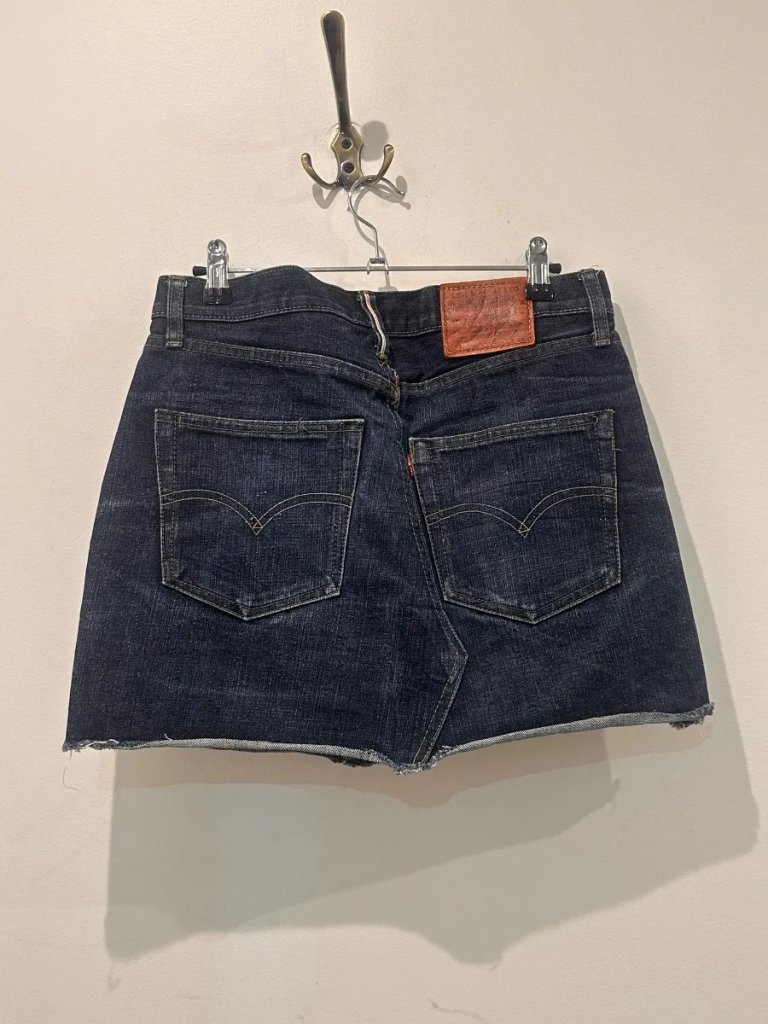
In a thrift-store bin or an online listing, one pair of Levi’s looks a lot like another. Yet between a 1960s 501 and a 1990s 501 the difference in value can be considerable, and almost everything comes down to a few square centimetres: the little red flag on the back pocket, the patch on the back of the waistband, a care tag sewn inside, a number stamped behind a button. At The Vintage Digger we handle a lot of denim — Levi’s, Girbaud and plenty more — and we have learned one simple rule: no single detail ever dates a pair of jeans; it is the agreement between the details that does. Here is our method, from the most visible clue to the finest.
1. The Red Tab: Big E or small e
The small red flag sewn onto the right back pocket, the “Red Tab”, first appeared in 1936 according to the Levi Strauss & Co. archives. At first the word LEVI’S was embroidered on one side only; by the early 1950s it appeared on both sides.
The best-known clue is the lettering. Until 1971 the word is spelled entirely in capitals, LEVI’S, with a capital E: the famous “Big E”. In 1971 the brand switched to Levi’s, with only the L capitalised: the “small e”. Levi’s says it plainly: a Big E tab means the jeans predate 1971. Allow for a transition period around that date, though, when both versions may have been on sale.
Three caveats before you get excited:
- The Big E is back. Levi’s reintroduced the Big E tab in 2018 for its premium products, and the Levi’s Vintage Clothing line uses it on its reissues. A Big E on its own proves nothing: it has to come with construction details that match the period.
- A blank tab is not necessarily a fake. According to Levi’s, part of the production — around 10% — gets a tab carrying only the ® symbol, to protect the trademark.
- Colour matters. An orange or white tab generally points to a line other than the classic 501 (fashion lines, non-denim trousers): a different family altogether.
2. The back patch: leather, card and “XX”
The patch sewn to the back of the waistband, with its two horses trying to pull a pair of jeans apart, dates back to 1886. It was made of leather. Levi’s explains that in the late 1950s the leather was replaced by a heavy card stock imitating leather, partly because automatic washing machines were so hard on the real thing. A genuine leather patch on a 501 therefore points to a pair made before that switch.
On a card patch, the printing reads like a calendar:
- “Every Garment Guaranteed”: this line disappears from the patch in the early 1960s.
- “501XX”: the double X, which denoted extra-strong denim, leaves the lot number in the late 1960s (around 1966–1968 according to collectors’ guides).
- A single letter (A, S, F…) next to the lot number shows up on patches from the very end of the 1960s.
- “Care instructions inside garment”: this refers to an inside care tag, so the pair is from the 1970s or later.
- “Made in U.S.A.”: on the mainline it disappears after 2003, when Levi’s last American factories closed.
Bear in mind that card patches crack, shrink, fade or wash away entirely. A missing patch dates nothing; it simply means you have to look elsewhere.
3. The inside care tag
This is often the most precise clue. Levi’s notes that care tags began appearing on its garments in the 1970s; collectors’ guides place the first sewn-in tag around 1971, after a short period at the end of the 1960s when washing instructions were printed on the pocket bag. The direct consequence: a 501 with no care tag at all, and no sign that one was cut off, generally predates the 1970s.
After that, the tag evolves in families:
- 1970s and early 1980s: a small white tag, English text and, at the bottom, a line of digits giving the month, the year (as a single digit) and the factory number. A “7” can therefore mean 1977 or 1987: the rest of the jeans settles it. The stated shrinkage changes from about 8% to about 10% around 1981.
- Late 1980s: the red batwing logo appears on the tag, along with “Care on reverse”, used until 1991. A red logo together with “Care on reverse” means a pair made after 1986.
- 1990s: care symbols are added to the text. From around 1993 the date code becomes four digits, month then year: 1295 reads December 1995.
- After 2003: multilingual tags, and mainline production outside the United States.
The tag also carries a factory number. Make a note of it: you will need it for the next step.
4. The number behind the button
Turn the waistband over and look at the back of the top button: there is a number stamped into it. It is not the lot number but the code of the factory that assembled the pair. Levi’s has never published an official list; what we know comes from collectors and should be read as a trend:
- a letter or a single digit (2, 5, 6, 8, or letters such as J, S, W): mostly the 1950s to the 1970s;
- two digits (10, 16, 17, 20…): mostly the 1960s to the 1980s;
- three digits (524, 544, 552, 555…): mostly the 1980s to the early 2000s;
- four digits, or mixed letters and digits: recent production, very often outside the United States.
Two codes come up again and again. 555 stands for the historic Valencia Street factory in San Francisco, opened in 1906 and closed in 2002; it is highly sought after, but it also appears on 1990s reissues, so on its own it does not guarantee an old pair. 524 is generally attributed to the El Paso factory in Texas.
The right reflex is to compare the button number with the one on the care tag. If they match, that is a good sign. If they differ, it is not necessarily a fake — a button may have been replaced, and collectors report mismatches on genuine pairs — but it is a reason to look at everything else more closely.
5. Rivets and stitching
The rivets tell a story that Levi’s documents precisely:
- The crotch rivet disappears during the Second World War, along with the back cinch, to save metal and fabric.
- Hidden rivets: in 1937 the back pockets started being sewn over their rivets so they would stop scratching furniture and saddles. You can feel them under the denim and see their heads inside the pocket.
- Bar tacks: in 1966 those hidden rivets were removed and replaced with dense bar tack stitching. A 501 with hidden rivets in the back pockets therefore predates 1966–1967.
Stitching details help narrow things down further. A V-shaped stitch next to the top button is found on pairs up to the late 1960s. Single-stitched back pockets are typical of the 1970s and give way to double stitching towards the end of that decade. Finally, Levi’s points out that nearly all its jeans made before the mid-1980s have a single felled inseam.
6. Selvedge and the “redline”
Turn a leg inside out and look at the outseam. If the fabric ends in a clean, woven edge trimmed with a red thread, you are holding a “redline”: selvedge denim woven on narrow looms by Cone Mills, which Levi’s used for the 501 from the late 1920s. This fabric was gradually phased out of the 501 in the early-to-mid 1980s, as production moved to wider looms; the outseam then becomes overlocked, its raw edges wrapped in a zigzag thread. As a rule, a redline 501 predates the mid-1980s.
Keep a cool head: Levi’s Vintage Clothing jeans and many current models are selvedge too. A redline only points to age if everything else agrees.
7. The model: 501, 505, 517
The lot number, on the patch or the tag, also guides the dating:
- 501: the button-fly jean, the original model. A zip-fly version, the 501Z, appeared as early as 1954.
- 505: the straight, zip-fly cut, born in the late 1960s (Levi’s reissues a “1967” version today).
- 517: the bootcut, introduced by Levi’s in 1969 to be worn over boots, originally in Sta-Prest fabric.
On a zip-fly model, the zipper brand offers a supporting clue: collectors’ guides associate Talon or Scovill with the 1970s, then a YKK zip engraved with Levi’s with the 1980s.
8. Made in USA or made in Europe
Levi’s closed its last two American plants, in San Antonio, Texas, at the end of 2003. On the mainline, a “Made in U.S.A.” label therefore means a pair made in 2003 or earlier; only a few premium reissues were later entrusted to American workshops.
Many vintage Levi’s found in France, however, were made in Europe: the brand produced on the continent for a long time, notably in Belgium and at La Bassée in northern France, until those factories closed in 1998–1999. These are genuine vintage Levi’s, just from a different supply chain: their tags and factory codes do not follow the American chronology exactly, and American-made pairs generally command higher prices.
Reissues and fakes: the traps
In 1992 Levi’s launched a first line of reissues known as “Capital E”, followed in 1996 by Levi’s Vintage Clothing (LVC), which reproduces archive models: Big E, redline, hidden rivets and all. They are excellent jeans, but not period pieces. Their recent inside tag usually gives them away, and the whole pair looks too new for the age the tab suggests.
Fakes are mostly betrayed by inconsistencies: a Big E on a pair whose care tag dates from the 1990s, a tab in the wrong shade of red, sloppy tab embroidery, an irregular or lopsided back-pocket arc (the “arcuate”). Hence our rule: every clue has to tell the same era.
Decade-by-decade summary
- Before 1937: exposed rivets on the back pockets, back cinch, leather patch; red tab from 1936, embroidered on one side only.
- From 1937 to the 1950s: hidden rivets, leather patch, Big E tab (embroidered on both sides from the early 1950s), no crotch rivet after the war, no care tag.
- 1960s: card patch, Big E, hidden rivets until 1966 then bar tacks, redline, V-stitch by the button, no sewn-in care tag; “501XX” becoming “501” at the end of the decade.
- 1970s: small e from 1971, first care tag with a single-digit year code, redline, single-stitched back pockets, button stamped with a letter or one or two digits.
- 1980s: small e, redline until the early or mid part of the decade then overlocked seams, double-stitched pockets, three-digit buttons, red batwing logo and “Care on reverse” at the end of the decade.
- 1990s to 2003: tags with care symbols and a four-digit date code, still plenty of “Made in U.S.A.”, 555 buttons on Valencia Street pairs (and on reissues).
- After 2003: mainline made outside the United States, multilingual tags.
Your questions
Does a Big E always mean “before 1971”?
No. Levi’s reintroduced the Big E in 2018 on its premium products, and its Levi’s Vintage Clothing reissues carry it too. A genuinely old Big E pair has no modern care tag and shows consistent details: patch, rivets, stitching, button number.
My jeans have no care tag: are they necessarily old?
Not necessarily: many owners cut it off. Look for stitching marks or a stub of fabric on the inside seam, then rely on the other clues. A missing tag only argues for age if nothing has been removed.
What does 555 behind the button mean?
It stands for the Valencia Street factory in San Francisco, which closed in 2002. A “555” 501 was sewn there, but it may be a 1990s pair just as easily as a reissue: the care tag will give you the date.
How do I choose my size in vintage Levi’s?
Don’t trust the number on the tag: old jeans have often shrunk over years of washing, and cuts have changed. Measure the pair flat (waist, inseam, rise) and compare it with a pair that fits you well. Our guide to vintage versus modern sizes explains the method.
Ready to put it into practice? Browse our vintage jeans in stock.
Discover our vintage pieces
Pieces from this story
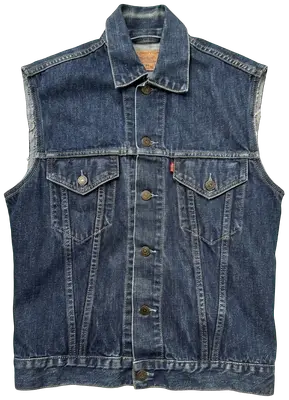 Image generated from the photo — the real photos are on the product page
Levi's
Levi's dark blue sleeveless denim jacket with metal buttons
€120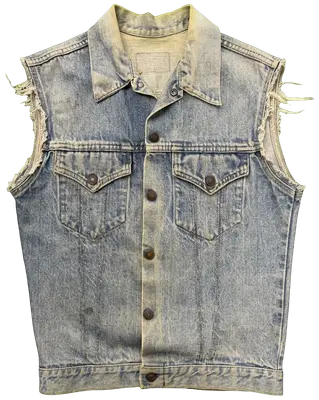 Image generated from the photo — the real photos are on the product page
Levi's
Faded sleeveless denim jacket with frayed edges
€110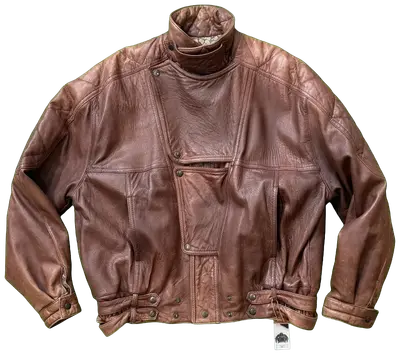 Image generated from the photo — the real photos are on the product page
VINTAGE
Brown leather aviator jacket with stand-up collar, asymmetrical snap button closure and…
€340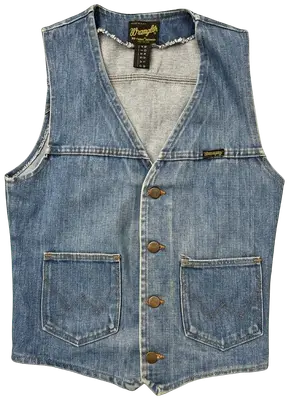 Image generated from the photo — the real photos are on the product page
Wrangler
Vintage light blue Wrangler denim vest from the No-Fault Denims line
€110Read next
Discover our vintage pieces
View shop