Our journal is written in French — English translations are on the way.
How to Date Vintage Marithé + François Girbaud by Its Labels
Labels, country of manufacture, buttons, straps and cuts: the method we use every week to place a Girbaud jean or jacket in time, and to tell it apart from fakes and recent reissues.
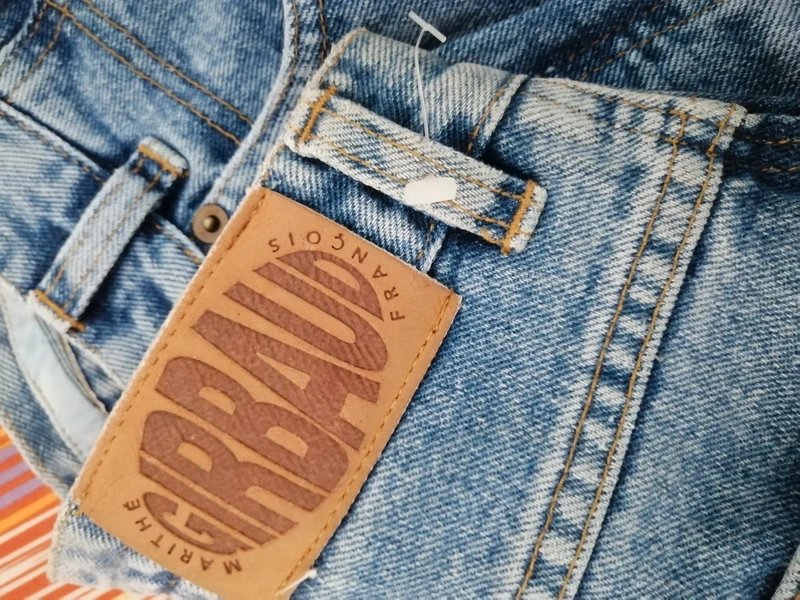
At The Vintage Digger, Marithé + François Girbaud is the brand that passes through our hands more than any other: jeans, trousers, jackets, shirts, now and then a coat forgotten at the bottom of a box. And the question we hear most is always the same: "What era is this from?" This guide sets out the method we use, clue by clue. It doesn't retell the history of the house — we did that in our article Marithé + François Girbaud: history, collections and lines — it shows you how to read a piece.
A word of honesty first: there is no official, public timeline of Girbaud labels. The house opened, renamed and sold many lines, and its products were made under licence in several countries. So you never date a piece on a single detail. You cross-check several clues and talk about a range, not an exact year.
1. Read the name: which line, which market?
The first reflex is to read exactly what the main label says, at the collar, the waistband or the fly. The house signature is "Marithé + François Girbaud", with the accents, the cedilla and the plus sign, often shortened to M+FG or MFG. But other names exist, and each points you towards a period:
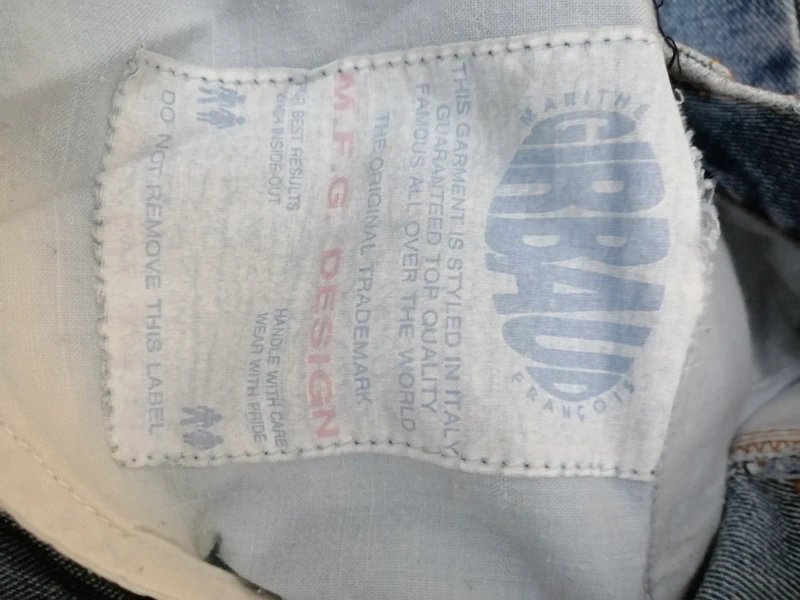
- Closed: a line born in the late 1970s under the Girbauds, taken over in the early 1990s by business partners in Hamburg. Today it is an independent German brand. A Closed piece that refers to the Girbauds generally belongs to the brand's early period; a recent Closed piece has no connection with them.
- Compagnie des Montagnes et des Forêts, Matricule 11342, Compléments, Maillaparty: lines the couple launched in the second half of the 1970s, according to encyclopedic sources. They are rare on the market.
- S.P.Q.R. City and the Métamorphojean: late-1980s concepts, sportier, with cuts shaped around the body's movement.
- "Girbaud" alone: the name the brand has used since its relaunch in late 2023. A label that reads only "Girbaud" deserves a careful look — though the word alone also appeared on some older pieces, notably for the American market.
2. The care label and country of manufacture
The small label sewn inside (composition, care, country) often tells you more than the logo.
Made in France, Italy, Spain: Europe first
On the pieces we see, European origins dominate: Made in Italy comes up again and again on 1980s-1990s jeans, jackets and Closed pieces, and we have also had pieces Made in Spain and Made in France. These are consistent with the house's golden age, but they date nothing on their own: a 2000s piece can be made in Italy too.
A piece for the American market
In the United States, the brand was run under licence: by VF Corporation from 1986, then by I.C. Isaacs, which took over the menswear licence in late 1997 and womenswear in early 1998. I.C. Isaacs' annual reports show that much of its production then came from Mexico, Asia and American factories. In practice:
- a label carrying an RN number (a company identifier registered with the US Federal Trade Commission) or a CA number (its Canadian equivalent) points to a piece made for North America;
- Made in Mexico or an Asian country, together with sizing in inches, usually matches that licensed period, from the late 1990s into the 2000s.
These are not fakes: they are official products made under licence — the very pieces you see in the hip-hop imagery of the time.
How long is the care label?
As a general rule, well beyond Girbaud, a short, plain care label tends to suggest an older piece, while a long multilingual one with batch codes points to more recent manufacture. It is a supporting clue, to be weighed with the rest.
3. Buttons, rivets and straps
On jeans or trousers, the hardware is an excellent witness.
- Engraved buttons and rivets: on the genuine pieces we handle, the waistband button and rivets carry the brand's name or initials. A plain, generic or plastic button on a pair of jeans should make you pause.
- M+FG markings: the brand liked to add a small M+FG tab or strap at the fly or the back of the waistband. Check the spelling and how crisp the marking is.
- Shuttle straps: the Shuttle trouser, with its Velcro straps for adjusting the waist and drape, dates from the late 1990s (one source places it in 1998). It became the brand's emblem in the United States. A strapped pair cannot be a 1980s piece.
4. Zips
Turn the fly over and read the zip puller: some carry a zip maker's name, others the brand's logo. We know of no documented rule linking a zip maker to a specific Girbaud period; a shiny new zip on heavily worn fabric, however, can point to a replacement. Not a serious flaw, but something a seller should mention.
5. Cuts and finishes
The cut often tells the era better than the label:
- 1980s: generous volumes, pleated trousers, broad-shouldered jackets, washed and softened fabrics. The house is known for industrialising stonewashing as early as the 1970s.
- Late 1980s and 1990s: the "anatomical" cuts of the Métamorphojean, with seams following the body's movement, then baggies, the Shuttle and wide cargo trousers.
- 2000s: laser finishes (the house explored them from the mid-1990s, launched laser writing on fabric in 2003 and Wattwash, laser fading without stones, around 2008), slimmer jeans, technical details.
6. Signs of a reissue or a fake
Two very different situations come up.
Recent, but official
After receivership in 2012 and the closure of its shops in 2013, the brand lived on: pop-up sales from 2015, a relaunch under the name "Girbaud" in late 2023, a Supreme collaboration in spring 2025. In Asia, a licence run by the Korean company LAYER produces its own collections, in a very different style (collegiate-inspired sweatshirts and knits). These pieces are genuine, but they are not vintage: a big-logo sweatshirt sold as "90s" deserves a second look.
The copy
Like any sought-after brand, Girbaud has its imitations. The signs that come up:
- a misspelt name (a missing accent proves nothing, but "Girbaut" or "Gribaud" on the label itself should worry you — as opposed to a seller simply misspelling the listing);
- generic, unmarked hardware;
- a poorly woven or blurry printed label, or one that looks heat-pressed;
- sloppy inside finishing, loose threads, uneven seams;
- no composition label on a piece that presents itself as recent.
The checklist at a glance
- Read the exact name: Marithé + François Girbaud, M+FG, Closed, a rarer line, or "Girbaud" alone.
- Read the country: Italy, France, Spain for Europe; Mexico or Asia with an RN/CA number for the US licence.
- Look at the length and number of languages on the care label.
- Check buttons and rivets: engraved, never plain or plastic on jeans.
- Spot the straps: if they're there, the piece dates from the late 1990s at the earliest.
- Read the cut and finish: 1980s volumes, 1990s baggies and cargos, 2000s laser.
- Be wary of big logos on sweatshirts sold as vintage.
- Never conclude on a single clue: give a range.
Frequently asked questions
Is a Closed piece a Girbaud piece?
For the early period, yes: Closed was created and run by Marithé and François Girbaud until it was taken over in the early 1990s. A recent Closed piece, however, belongs to today's German brand and has no link with the designers.
Are "Made in Mexico" Girbaud jeans fake?
Not necessarily. In the United States the brand was made under licence, and the licensee's own reports mention production in Mexico and Asia. They are official pieces for the North American market, usually from the late 1990s or the 2000s.
Can you date a piece to the exact year?
Rarely. Unless there is a collection tag or an original document, we talk about a decade or a range ("late 1980s", "1990s"). Be wary of listings that are very precise without saying what they rely on.
Are pieces sold as "Girbaud" today vintage?
No. Since its relaunch in late 2023, the brand has been selling new collections under the name "Girbaud". They are genuine but recent. Vintage means pieces made before the shops closed in 2013.
Ready to put the theory into practice? Browse our Marithé + François Girbaud pieces in stock.
Discover our vintage pieces
Pieces from this story
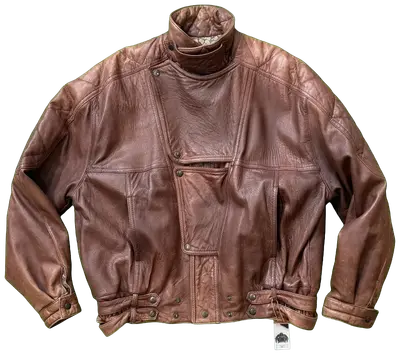 Image generated from the photo — the real photos are on the product page
VINTAGE
Brown leather aviator jacket with stand-up collar, asymmetrical snap button closure and…
€340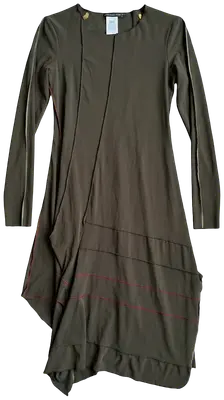 Image generated from the photo — the real photos are on the product page
Marithé + François Girbaud
Robe kaki foncé MFG
€280 Image generated from the photo — the real photos are on the product page
Marithé + François Girbaud
Marithé+Francois Girbaud Cravate killer full skirt
€190 Image generated from the photo — the real photos are on the product page
Marithé + François Girbaud
Short Skirt
€170Read next
Discover our vintage pieces
View shop