Our journal is written in French — English translations are on the way.
Vintage Moschino and Versace: how to tell an authentic piece
Labels by line and era, novelty buttons, the Medusa, Made in Italy, Redwall belts: our method for telling a genuine Moschino or Versace piece from the 80s to the 2000s from a copy.
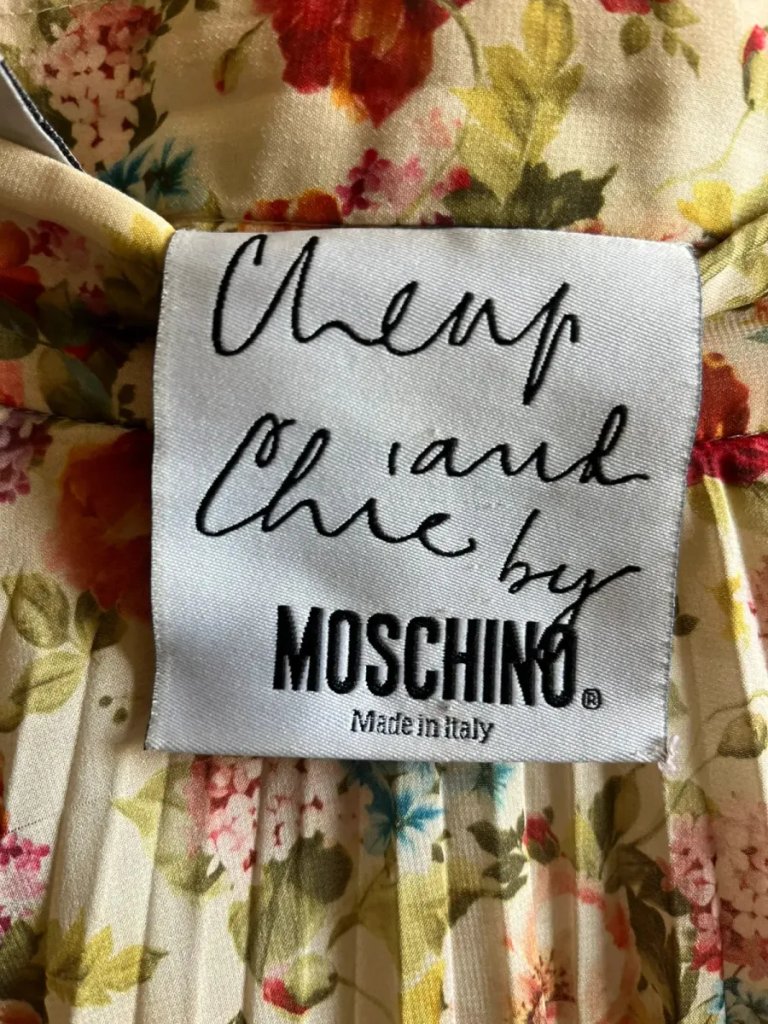
Moschino and Versace invented two languages that shaped Italian fashion in the 80s and 90s: Franco Moschino’s surreal humour on one side, Gianni Versace’s Medusa and baroque prints on the other. Two signatures you recognise at first glance… and that is precisely the problem. They are also two of the most copied houses on the second-hand market, on clothing as well as belts and bags. A golden Medusa or a slogan in capital letters never proves on its own that a piece is authentic.
Before it reaches the shop, every Moschino or Versace piece goes through our hands: we look at the label, the composition, the buttons and the finishing, and we check that all these clues tell the same story. Here is the method we use, line by line and era by era, in the same spirit as our guide to authenticating vintage Burberry. It does not replace the opinion of a professional authenticator on a very expensive piece, but it will help you rule out the vast majority of copies and misdated pieces.
The golden rule: identify the line before judging the piece
Both houses multiplied their secondary lines. A label is therefore not ‘real’ or ‘fake’ in the abstract: it has to match the line and the period the seller claims. A diffusion-line label on a piece presented as mainline, or a 2010s label on a piece sold as ‘90s’, is as important a warning sign as a spelling mistake. Always compare with authentic examples from the same line and the same decade, never with the current label you see in stores today.
Bear alterations in mind too: a garment that has been shortened or taken in may have lost a label, or had it moved. That is not proof of a counterfeit, but it means relying more heavily on the other clues.
Moschino: recognising the lines and labels
A few landmarks for dating
Franco Moschino (1950-1994) launched his house in Milan in 1983, through his company Moonshadow, with the Moschino Couture! line — the exclamation mark is part of the name. Moschino Jeans followed in 1986, then Moschino Cheap and Chic in 1988, a less expensive line with the same mischievous spirit. After the designer’s death in 1994, his close collaborator Rossella Jardini took over as creative director. The Italian group Aeffe, the house’s production partner from the start, took a majority stake in 1999.
Two very useful dating landmarks: Moschino Jeans became Love Moschino in 2008, and Cheap and Chic was folded into Boutique Moschino from 2014, under Jeremy Scott. A Love Moschino or Boutique Moschino label therefore cannot be ‘from the 90s’: the piece may be perfectly genuine, but it is more recent than claimed.
What the labels tell you
- Moschino Couture!: the line name appears with its exclamation mark. On 80s and 90s pieces, the lettering is black, crisp and bold, often alongside a Made in Italy mention.
- Moschino Cheap and Chic: from the late 80s into the 90s, the line used a very recognisable cursive script, on its labels as in its advertising, before the typeface changed.
- Moschino Jeans: a label of its own, which disappears with the 2008 name change.
- Made in Italy: this is the norm on the vintage pieces we handle. Any other origin on a piece described as 80s or 90s deserves questions.
- Care labels: on vintage pieces they stay simple. Long, shiny polyester labels stacked on top of one another, with instructions and warnings in several languages, or a website address, point rather to a piece from the 2000s or later.
A little-known trap: you will come across 80s ‘Cheap and Chic’ labels that do not carry the Moschino name and belong to other brands. Without the word Moschino, the wording alone proves nothing.
Buttons and novelty details
Franco Moschino loved subverting details: jackets with windmill-shaped buttons, a suit whose buttons depict the masks of comedy and tragedy, trompe-l’œil collars and pockets… On an authentic piece, these novelty buttons and trims are carefully made: clean casting, a tidy reverse, a solid fastening, even stitching. A crude novelty button, with blurry casting or a poorly finished back, is a warning sign, especially next to a doubtful label.
Belts and bags: the Redwall case
The famous gold-letter belts and a large share of vintage Moschino leather goods were made in Italy by Redwall, a leather goods maker from the Bologna area. Authentic pieces therefore often carry a marking that pairs Moschino and Redwall with a Made in Italy mention, stamped into the leather or engraved on the back of a metal element. It is a good clue… but counterfeiters reproduce it too. Look at the quality of the leather, the sharpness of the letters, how they are fixed and where the marking sits, and compare with pieces that have already been authenticated. The letter belt is among the house’s most counterfeited accessories: be doubly careful.
The ‘fake’ that isn’t one
One last, very Moschino subtlety: the house itself played with the idea of the fake and of fashion taking itself too seriously. The slogan ‘Stop the Fashion System’ became a motif in its own right, and authentic pieces carry deliberate winks at fakery, such as a ‘100% fake gold’ or a trompe-l’œil necklace. A provocative slogan is therefore not a sign of counterfeiting: quite the opposite, it is often pure Moschino. The label and the make are what settle the question.
Versace: from Gianni Versace to Versace Jeans Couture
The lines to know
Gianni Versace presented his first collection in Milan in 1978. Up to his death in 1997, and in the years that followed, the house developed a whole family of lines that you need to be able to tell apart:
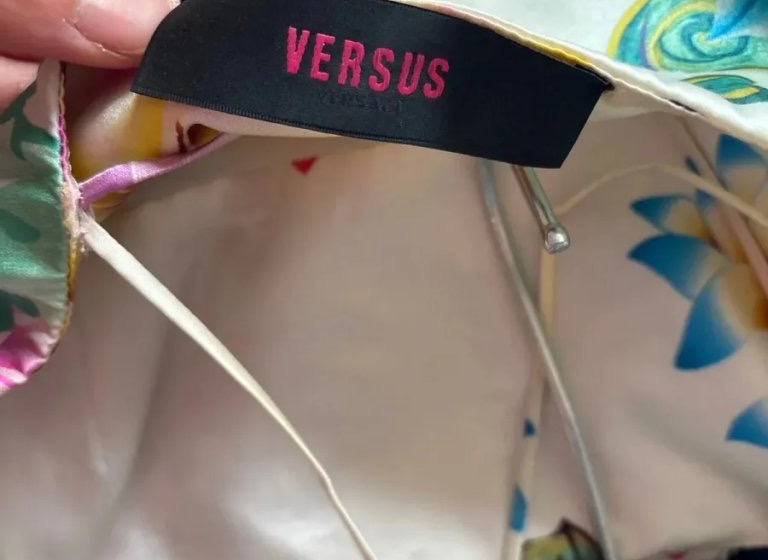
- Gianni Versace: the main line, home of the great printed silks and the tailoring. On pieces from the period, the label often reads ‘Gianni Versace Couture’.
- Versus: launched in 1989, a gift from Gianni to his sister Donatella, younger and more rock. A Versus label therefore cannot date from the early 80s.
- Istante: a secondary line very present in the 90s, with structured cuts and bold prints.
- Versace Jeans Couture and Versace Sport: the house’s denim and sportswear, made under licence by the Italian group Ittierre, notably in the late 90s and up to 2009.
- Versace Classic V2: a more classic line, produced from the mid-90s by a joint venture with Ermenegildo Zegna.
Reading the main label and the care label
Versace labels changed a great deal: the lettering of the name, the place of the Medusa, the colours. Labels signed Gianni Versace generally point to the 80s and 90s; later, the plain Versace name takes over. On vintage pieces, Made in Italy is the rule; production in Asia points rather to the 2000s or later.
The care label is often more telling than the main label. On older pieces it is usually white, headed with the Gianni Versace name, with the company form S.p.A. and sometimes a Milan address. On older Versace Jeans Couture pieces, a small authenticity label certifies manufacture by Ittierre S.p.A. These are details that copies reproduce badly, or forget altogether.
Signs that should alert you
- A small generic label reading ‘VERSACE – 100% COTTON – MADE IN ITALY’, with no address, no code and no care symbols: one of the most widespread counterfeit patterns.
- Spelling mistakes on the composition label, mangled Italian (along the lines of ‘HEAL IZZATO ITALIA’) or clumsy English.
- A ‘template’ label left blank, with MODEL, QUALITY, COLOUR and SIZE boxes never filled in.
- A blurry, flattened or crudely drawn Medusa on a button, an embroidery or a buckle.
The Medusa and the prints: look, don’t trust
The Medusa is probably one of the most copied symbols in luxury: on its own, it authenticates nothing. On an authentic piece, Medusa-head buttons and hardware show a detailed face, in relief, with sharp features; be wary of flat, clogged Medusas, or ones that don’t really look like the house’s drawing. The same goes for the Barocco and Greca (Greek key) prints, endlessly reproduced by copyists, including in gold, rhinestone or sequinned versions: no single print detail is enough to decide. Judge the whole: a supple, dense silk or cotton, even seams, clean interior finishing.
What about the Certilogo code?
Recent Versace pieces carry an authentication code (Certilogo, then a scannable tag). On a piece from the 80s or 90s, its absence is normal: demanding one on vintage is a mistake. Conversely, a code on its own is not enough: the most carefully made counterfeits copy the full label set too, QR code included.
The shared checklist before you buy
- Identify the line (Couture!, Cheap and Chic, Jeans; Gianni Versace, Versus, Istante, Jeans Couture…) and check that it existed at the claimed date.
- Compare the label with authentic examples from the same line and the same decade, not with today’s label.
- Read the care label: spelling, company name, symbols, consistency with the era.
- Look for Made in Italy on an 80s-90s piece, and question any other origin.
- Spot anachronisms: shiny polyester labels stacked in several languages, a web address, Love Moschino or Boutique Moschino on a ‘90s’ piece.
- Examine buttons and hardware: clean casting, a Medusa in relief, tidy markings on the reverse.
- Feel the fabric and turn the piece inside out: dense material, even seams, neat interior finishing.
- Never rely on a single clue: neither a Medusa, nor a slogan, nor a code proves authenticity on its own.
- Ask for detailed photos of every label and of the inside before buying remotely.
Frequently asked questions
Can a Moschino or Versace piece without a label be authentic?
Yes, a label may have been cut out or removed during an alteration. But without it, authentication rests entirely on the cut, the fabric, the buttons and the print, and becomes much less certain. For an expensive piece, we advise walking away or asking a specialist.
Is the exclamation mark in Moschino Couture! a reliable clue?
It is part of the line’s name, so it should be there on a Moschino Couture! label. But a counterfeiter can reproduce it too: it is a necessary clue, not a sufficient one. Check it against the lettering, the care label and the make.
Versus, Istante, Versace Jeans Couture: is that ‘real’ Versace?
Yes, these are official lines of the house, often more affordable than the main line. What matters is that the label matches the line and the era claimed: a Versus piece sold as ‘Gianni Versace Couture’, or dated before 1989, should make you pause.
Is a Moschino piece with the word ‘fake’ on it a counterfeit?
Not necessarily, quite the contrary: Franco Moschino loved mocking the fashion and luxury system, and the word ‘fake’ is part of his vocabulary. Judge the piece on its label, its composition and its make, not on its slogan.
Ready to put this into practice? Discover our Moschino pieces and our Versace pieces, all checked by us before going on sale.
Discover our vintage pieces
Pieces from this story
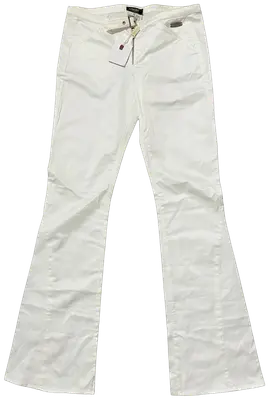 Image generated from the photo — the real photos are on the product page
Versace
New with tags Versace Jeans Couture white flared pants
€240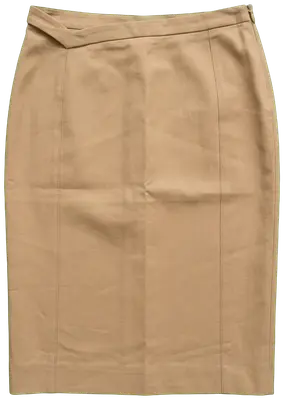 Image generated from the photo — the real photos are on the product page
Versace
Versace beige knee-length pencil skirt
€210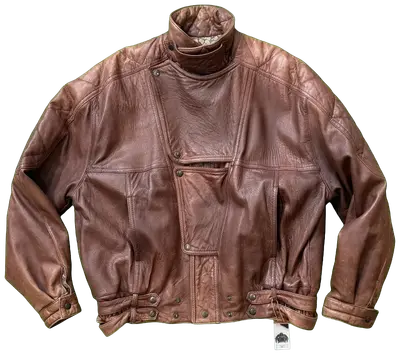 Image generated from the photo — the real photos are on the product page
VINTAGE
Brown leather aviator jacket with stand-up collar, asymmetrical snap button closure and…
€340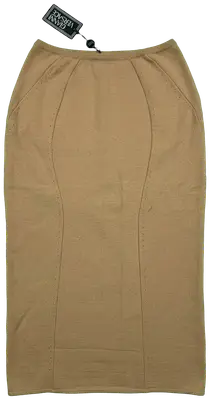 Image generated from the photo — the real photos are on the product page
Gianni Versace
Gianni Versace Couture camel knit pencil skirt, new with tags
€220Read next
Discover our vintage pieces
View shop