Our journal is written in French — English translations are on the way.
Vintage Kenzo: how to authenticate and date a piece
Jungle Jap, Kenzo Jeans, Kenzo Jungle, the tiger sweatshirt… Labels, lines, country of manufacture and prints: our clue-by-clue method to tell whether a Kenzo piece is genuine, and which era it comes from.
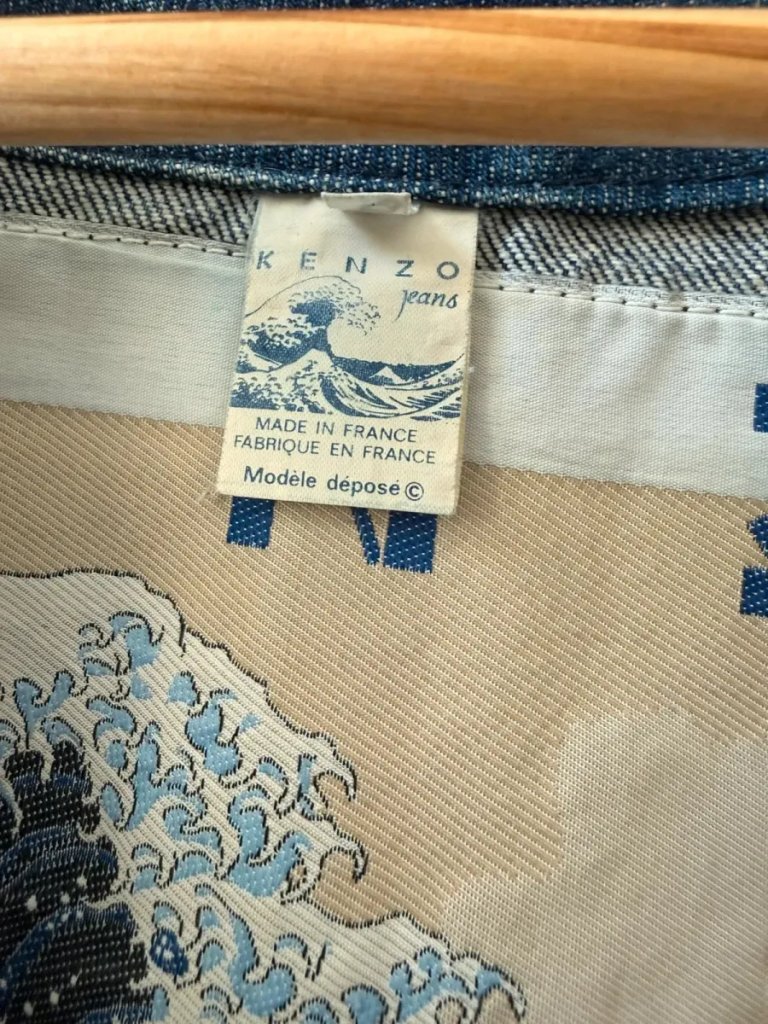
A shirt bursting with flowers, a jumper layered with clashing patterns, a jacket in bold colours rescued from the bottom of a trunk: the house founded by Kenzo Takada left behind some of the most joyful pieces in Parisian fashion. They are also among the most sought-after on the second-hand market… and therefore among the most often misdated, misdescribed or even copied. Kenzo is one of the houses we love hunting for most. Here is the method we recommend, clue by clue, to answer two questions: is it really Kenzo, and from which era?
A word of warning first, the same as in our guide to authenticating vintage Burberry: no single clue is enough on its own. It is the consistency of the whole — label, line, manufacture, cut, print, finishing — that lets you reach a conclusion.
The landmarks: Kenzo's history in a few dates
Dating a piece means knowing the main milestones of the house. These are the well-documented ones:
- 1970: Kenzo Takada opens a small boutique in the Galerie Vivienne in Paris, painting its walls with a jungle inspired by Henri Rousseau's The Dream. He names the shop, and his label, Jungle Jap.
- Mid-1970s: the name, considered offensive, is dropped in favour of Kenzo. The Place des Victoires boutique opens in 1976.
- 1983: first menswear collection.
- 1986: launch of men's and women's jeans and of a children's line, Kenzo Jungle.
- 1993: the house joins the LVMH group.
- 1999: Kenzo Takada retires from fashion. Gilles Rosier (womenswear) and Roy Krejberg (menswear) take over, followed by Antonio Marras, the duo Carol Lim and Humberto Leon (appointed in 2011), Felipe Oliveira Baptista (2019) and Nigo (since 2021).
For a vintage lover, the most telling dividing line is therefore 1999: before it, pieces were designed under the founder's direction; after it, other designers reinterpreted his vocabulary. Both periods have their appeal, but they are not valued the same on the market, and a serious seller should be able to tell you which one their piece belongs to.
Clue no. 1: the name on the label
The first reflex is to read what is actually written on the main label, usually sewn at the neckline or waistband. The name alone already tells you a lot.
“Jungle Jap” and “Kenzo Jap”: the early years
A label that mentions “Jap” points to the beginnings of the house. The Centraal Museum in Utrecht, for example, holds a blouse dated around 1980 whose label reads “KENZO JAP – MADE IN FRANCE”, and the Victoria and Albert Museum in London holds an early-1980s ensemble attributed to Jungle Jap. These pieces are rare and sought-after — which is exactly why they deserve the closest scrutiny.
“Jungle” alone: not necessarily a fake
You will come across “Jungle Paris” labels without the Kenzo name. On the Vintage Fashion Guild forum, collectors traced a US trademark record linking “Jungle Paris” to the Kenzo company. Such a label is not suspicious in itself, but it needs to be confirmed by everything else about the piece.
Diffusion lines and licences
Over the years the house multiplied its lines. Recognising them saves you from paying main-line prices for a secondary-line piece:
- Menswear (you will notably find Kenzo Homme labels): since the first men's collection dates from 1983, a men's piece cannot be older.
- Kenzo Jeans and Kenzo Jungle (children): launched in 1986, in a more casual spirit.
- Kenzo City (1988) and Bambou (1994): two lines listed by the Vintage Fashion Guild.
- Album by Kenzo: an inexpensive line made under licence for the American chain The Limited, from 1984.
- Kenzo Studio: a licensed line launched in 1995, sold in the United States and in Kenzo stores in China.
- Kenzo Golf and many accessories made in Japan: the house granted Japanese licences, for instance for scarves and handkerchiefs. We found no documented history of the golf line: treat it as a sportswear line, not as a major collector's piece.
A secondary line is not a fake: it is a different range, at a different price. The trap is buying it as a runway piece.
Clue no. 2: the typography and how the label is attached
The lettering of the word “KENZO” evolved over the decades. Vintage Fashion Guild collectors regularly date a label by comparing its font with period advertisements and runway footage: in one of their discussions, a label was matched to a late-1970s advert and to footage of the autumn-winter 1984 show. That is the method we recommend: compare your label with reliably dated pieces (museum collections, press archives, advertisements) rather than with resale listings, whose dates are often just estimates.
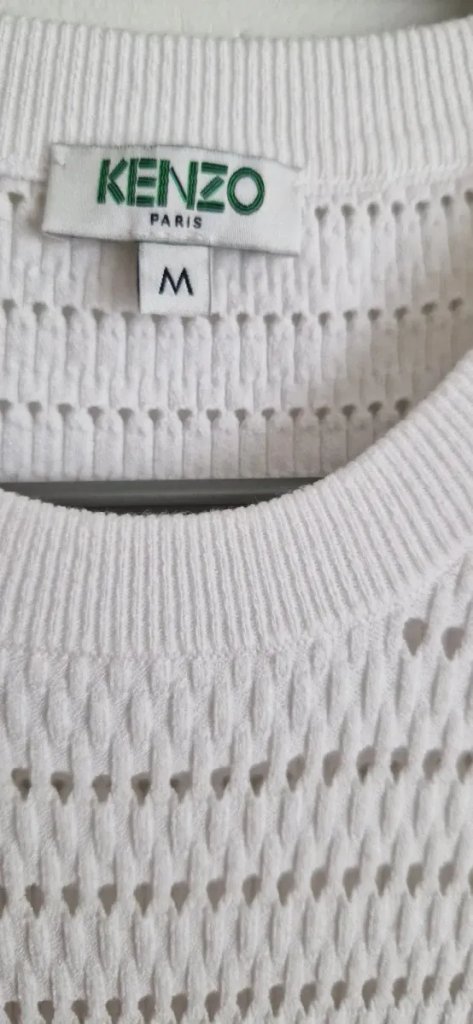
Also look at how the label is attached. A woven label sewn on straight, with even stitches in a matching thread, is reassuring. Coarse stitches, thread of a different colour or traces of earlier stitching around it are warning signs: as Vintage Fashion Guild members point out, a label can perfectly well have been re-sewn onto a garment that has nothing to do with Kenzo.
Clue no. 3: the country of manufacture
The earliest labels that can be checked in public collections read “Made in France”. Later, like most houses, Kenzo had pieces made in other countries: you will find pieces produced in Italy, Portugal or Eastern Europe, and licensed items made in Japan. The country alone therefore does not date a piece. It must, however, be consistent with everything else: “Made in Japan” is ordinary on a scarf or a licensed-line piece; on a piece presented as a 1970s main-line creation, it calls for serious checking.
Clue no. 4: the composition and care label
On more recent pieces, the care label is an excellent tool. It should show a style reference, the brand name, the place of manufacture and care instructions in several languages. Smudged printing, letters that are abnormally thin or thick, badly proportioned care symbols or spelling mistakes are typical of copies. On the oldest pieces, the composition label may be brief or even missing: that is not a flaw in itself, just one less clue to work with.
Clue no. 5: the tiger, the most common trap
The tiger has been part of the Kenzo imagery from the start: it comes from the Rousseau painting that decorated the first boutique. But the famous sweatshirt with the embroidered tiger head and “KENZO PARIS” is not an archive piece from the Takada years. It was born under Carol Lim and Humberto Leon: first a jumper in the autumn-winter 2012 collection, then a sweatshirt version whose first run sold out within hours. It is also the Kenzo piece covered by the largest number of specialist authentication guides.
The practical consequence: a tiger-head sweatshirt sold as “80s vintage” or “90s vintage” is, at best, misdated. It may be genuine, but it dates from 2012 or later. For these recent pieces, specialist guides look at the weight of the letters on the neck label (notably the “K” and the “E” of KENZO), the “PARIS” lettering of the embroidery and the crispness of the care label. Since there are many versions, always compare with photos of a verified example from the same season, and use an authenticator for a significant purchase.
Clue no. 6: prints, fabrics and construction
Pieces from the Takada era share a recognisable vocabulary: flowers, checks, grids and organic shapes boldly mixed, vivid colours, Japanese influences (kimono sleeves, kimono fabrics paired with market finds) and, in the mid-1970s, the loose volumes of the “Big Look”. An old Kenzo print is rich, but controlled: patterns and colours balance each other instead of fighting.
What often gives a copy away, whatever the brand, is the finishing: poorly registered print colours, uneven seams, sloppy hems, a cheap lining on a piece meant to be high-end. Examine the inside of the garment as closely as the outside: that is often where the difference shows.
Buttons and fastenings complete the picture. We found no reliable source describing buttons specific to each Kenzo era, so do not take an engraved button as absolute proof; check instead that it is consistent with the quality and age of the garment. A very light plastic button on a wool coat presented as a collector's piece should make you wonder.
Our summary checklist
- Read the label: Jungle Jap, Kenzo Jap, Jungle, Kenzo, a secondary line or a licence?
- Place the line in time: menswear from 1983, jeans and Kenzo Jungle from 1986, Kenzo Studio from 1995.
- Compare the typography with reliably dated pieces (museums, adverts, runway shows).
- Check how the label is sewn: straight, even, with no sign of re-stitching.
- Make sure the country of manufacture fits the line and era claimed.
- Read the care label: reference, brand, country, crisp and well-proportioned symbols.
- Be wary of a tiger-head sweatshirt sold as “80s–90s vintage”: it dates from 2012 or later.
- Examine the print and the inside finishing: controlled richness, even seams, a well-made lining.
- If in doubt about a valuable piece, ask for more photos or an expert opinion.
Frequently asked questions
How can I tell whether a Kenzo piece predates 1999?
There is no single sign. It is the combination of the line (and its launch date), the style of the label compared with dated pieces, and the style of the garment itself that gives a reliable range. Labels bearing “Jap” belong to the earliest years of the house.
Is a “Kenzo Jungle” or “Jungle Paris” label genuine?
Kenzo Jungle really was a line of the house, launched in 1986 for children, and the “Jungle Paris” trademark was registered to the Kenzo company. Such a label is therefore not suspicious in itself; it simply has to be consistent with the rest of the piece.
Is “Made in Japan” a sign of a fake?
No. The house granted licences in Japan, notably for accessories such as scarves and handkerchiefs. What matters is the consistency between the country, the line and the era claimed.
Can a tiger-head sweatshirt be vintage?
The “KENZO PARIS” tiger-head sweatshirt appeared in 2012. It may be genuine and already more than ten years old, but it does not belong to the Kenzo Takada era. Older jungle prints featuring tigers are offered by specialist dealers, but they look nothing like this embroidered patch.
Ready to put the theory into practice? Browse our vintage Kenzo pieces in stock.
Discover our vintage pieces
Pieces from this story
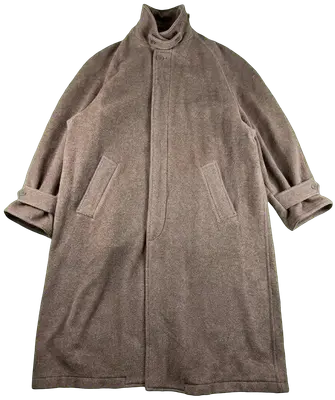 Image generated from the photo — the real photos are on the product page
Kenzo
Manteau long Kenzo en laine et mohair marron
€800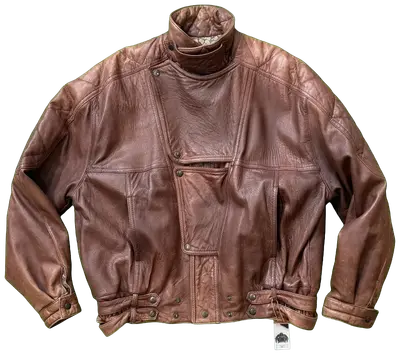 Image generated from the photo — the real photos are on the product page
VINTAGE
Brown leather aviator jacket with stand-up collar, asymmetrical snap button closure and…
€340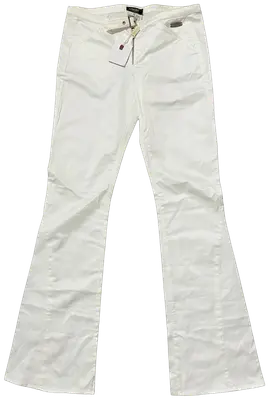 Image generated from the photo — the real photos are on the product page
Versace
New with tags Versace Jeans Couture white flared pants
€240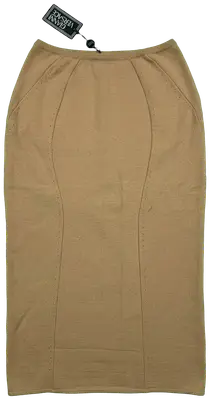 Image generated from the photo — the real photos are on the product page
Gianni Versace
Gianni Versace Couture camel knit pencil skirt, new with tags
€220Read next
Discover our vintage pieces
View shop